






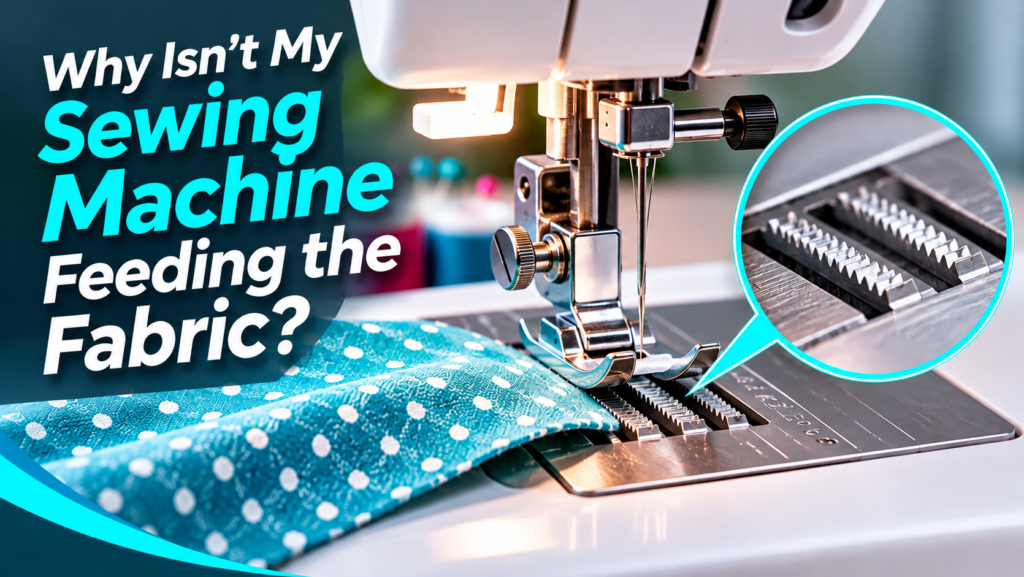
If your sewing machine is stitching in one place or the fabric isn’t moving underneath the presser foot, the problem is usually related to the feed dogs, presser foot or machine settings.
Here are the most common things to check, starting with the quickest fixes.
1. Check the Feed Dogs
Feed dogs are the small metal teeth underneath the presser foot that move your fabric through the machine. Some machines allow you to lower them for free-motion quilting and darning, and if they’ve accidentally been left down, the fabric won’t feed normally.
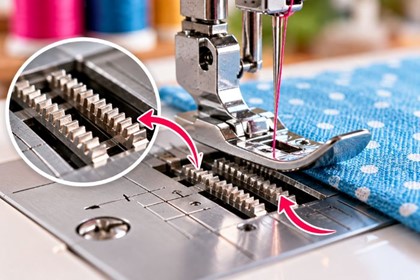
Feed dogs rising through the needle plate
Raise them again according to your machine’s instructions. Depending on the model, the control might be a switch, lever, button or electronic setting. You may need to turn the handwheel one complete revolution, or start sewing, before they fully re-engage.
2. Lower the Presser Foot
It sounds obvious, but check that the presser foot is completely lowered before sewing. The presser foot holds the fabric against the feed dogs so they can move it through the machine. If it’s raised, the feed dogs have nothing to grip against.
3. Check the Stitch Length
If your stitch length is set extremely short or close to zero, the fabric may barely move. A setting of zero stops the feed dogs moving the fabric altogether, which is exactly what you want for free-motion work but not for ordinary sewing. For general sewing, try a stitch length of around 2.5mm as a starting point, then adjust to suit your fabric.
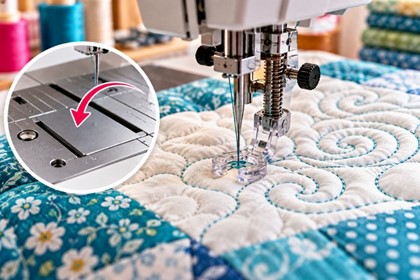
Free-motion quilting with the feed dogs lowered
4. Check Presser-Foot Pressure
Some sewing machines allow you to adjust the amount of pressure the presser foot applies to the fabric. If it’s set incorrectly, certain lightweight, thick or slippery fabrics may not feed properly. Too little pressure and the fabric can slip rather than being pulled through, while too much can make it drag.
Return the dial to the normal setting and test again, then adjust gradually if you’re working with a particularly delicate or bulky fabric.
5. Clean Around the Feed Dogs
Lint and thread can accumulate underneath the needle plate and around the feed dogs, and a heavy build-up can stop the teeth gripping the fabric. Switch the machine off and clean the area according to the manufacturer’s instructions, using the small brush supplied with your machine. If your manual shows how to remove the needle plate, this gives access to the areas where the most lint collects.
6. Check the Needle
A bent, blunt or badly fitted needle can upset the way the fabric feeds. Fit a new needle, make sure it’s pushed fully into place, and choose a type and size that suits your fabric.
7. Don’t Pull the Fabric
Avoid pulling or pushing the fabric through the machine. This can bend or break the needle and stretch the fabric, and it can distort your seam. Let the feed dogs move the fabric naturally while you simply guide it.
Is the Fabric Too Thick?
If the problem only happens when sewing several thick layers, your machine may be struggling to feed the material. Very bulky fabrics and stacked seams leave the feed dogs too little room to pull everything through evenly.
Use the correct needle, sew slowly and consider a walking foot where appropriate, since this helps feed the top layer while the feed dogs move the bottom one. Some machines have a built-in equivalent, such as Pfaff’s IDT or Janome’s AcuFeed, which feeds the top layer from above. Don’t force very thick fabric underneath the presser foot. Slippery fabrics can also feed more reliably with a walking foot, or with the layers pinned or clipped together.
Quick Check
If your fabric isn’t moving, work through the checks in order. Raise the feed dogs, lower the presser foot, check the stitch length, clean around the feed dogs and then test again on a scrap of the same fabric before returning to your project.
If the feed dogs are raised but still aren’t moving when you operate the machine, there may be a mechanical issue requiring professional attention. A machine that has gone a long time without servicing can also feed poorly, so it’s worth having it checked if the simple fixes make no difference.
In most cases, start by checking the feed dogs, particularly if you’ve recently been free-motion quilting or darning.