





Most of the attention in a sewing room goes to the sewing machine. But experienced dressmakers spend almost as much time pressing as they do stitching, and pressing equipment is usually the last thing anyone upgrades.
When you are building a sewing setup, the money goes where the stitching happens. A sewing machine first, then an overlocker, better scissors, cutting mats, and the accessories that make everything easier. Pressing equipment tends to be whatever iron was already in the house.
That is worth reconsidering, because pressing is not a finishing task. It happens throughout construction, it decides how flat and accurate everything sits, and it is the single clearest difference between a garment that looks handmade and one that looks made. Here is what an ironing press actually does, and how to judge whether you need one.
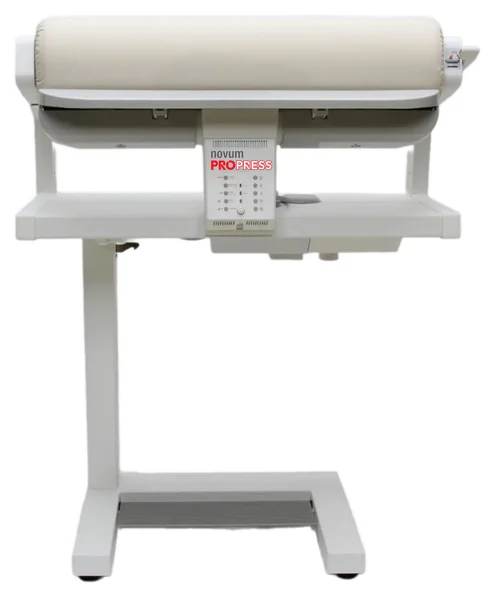
A rotary roller press: the padded roller pulls the fabric in against a heated element, and you guide the edges sitting down. Novum Rotary Roller ProPress 560
01. Pressing is not the same as ironing
Ironing a shirt means moving the iron backwards and forwards across the cloth until the creases go. Pressing with an iron press means putting heat and weight onto one specific area and lifting straight off again — no sliding, because sliding distorts a seam that has not yet been sewn into anything.
In sewing you press to set stitches into the fabric, to flatten a seam allowance, to form a sharp fold before you stitch it down, and to prepare a piece for whatever happens to it next. Same tool, different job, and a press is built for the second one.
02. What an ironing press actually is
An ironing press applies heat and pressure across a far larger area than a hand iron, and it does the pressing for you rather than asking your arm to supply the force. Instead of working across a length of fabric in a dozen passes, you lay the fabric on the surface, close or feed it through, and let heat and pressure do the work. Most presses offer steam as well as dry heat.
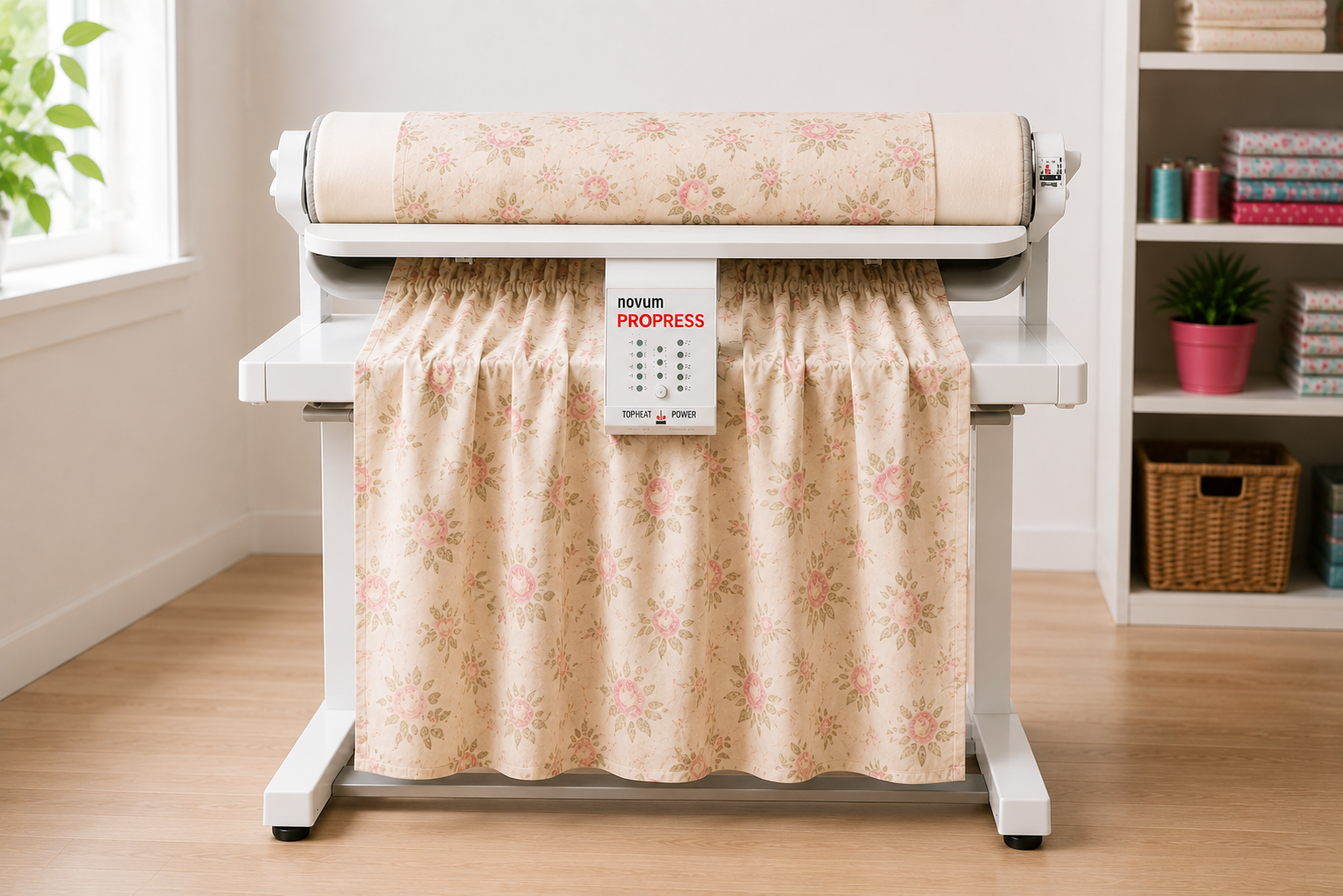
Two designs are common, and GUR stocks both. A flatbed press closes two large heated surfaces together like a clamshell, which suits pressing in sections and is the more familiar shape for garment work. A rotary roller press draws fabric between a rotating padded roller and a heated element, so the roller feeds and cushions while the heated surface does the pressing and a long piece runs through continuously — sheets, curtain panels, quilt backs and dress fabric come out flat in one pass.
Either way the numbers that matter are the width of the pressing surface, how much pressure it applies, whether it steams, and how quickly it heats. A roller of 67cm or 85cm covers most home sewing; pressing forces around 600 newtons are well beyond anything you can lean on an iron.
03. Pressing starts before the first stitch
Creased fabric cannot be cut accurately. If a pattern piece sits over a fold or a wrinkle, the piece you cut is not the shape you drafted, and every error introduced at the cutting stage has to be fought for the rest of the project.
This is the least glamorous use of a iron press and probably the most valuable. A few metres of fabric straight off the roll, or out of a prewash, flattens in a fraction of the time it takes with an iron, and you get a genuinely smooth surface to measure, mark and cut on.
04. Press as you sew, not at the end
Every seam gets pressed before the next one crosses it — open, or to one side, depending on the pattern. Do that as you build the garment and the pieces sit correctly when they meet. Leave it all to the end and you are trying to iron a three-dimensional object whose seams have already dried in the wrong position, reaching inside a sleeve with the tip of an iron.
One refinement worth knowing, and the one most beginners miss: set the seam before you open it. Press the seam closed first, exactly as it came off the machine, which drives the stitches into the fabric. Then open it and press it flat. Quilters treat this as standard, and it is the difference between a seam that lies down and one that keeps lifting.
There is a rhythm to it that experienced sewists follow without thinking, and it is the one habit that most improves a beginner’s results.
Sew it, press it, then move on to the next stage.
05. What pressing does to the finish
Take two identical garments, press one properly throughout construction and skip it on the other, and the difference does not look like a difference in care. It looks like a difference in skill. Pressing is what produces:
Skip it and seams stay bulky, hems wander, and the whole thing reads as unfinished — however neat the stitching underneath. The sewing machine joins the pieces together. Pressing is what gives the project its shape.
06. Where the large surface earns its keep
The case for a iron press gets stronger the bigger your projects are. Curtains, bedding, tablecloths, quilt backs and dress lengths all involve pressing metres of cloth that a hand iron covers in small overlapping passes. An ironing press covers it in one movement, which is a convenience if you sew occasionally and a real time saving if you sew several times a week or sell what you make.
Quilters and patchworkers get a second benefit: accuracy. In patchwork, small inconsistencies multiply as blocks are joined, and a seam that is not properly flat throws off every measurement after it. Consistent pressure across a whole block helps seams lie flat and makes accurate joins much easier. As the piece grows, being able to flatten a large section at once stops becoming convenient and starts becoming necessary.
Dressmaking is the other clear case. You press before cutting and then return to the pressing station after almost every stage — seams, darts, hems, facings, waistbands. Having a press permanently set up and hot, rather than an iron and board to be dragged out, changes the whole workflow.
07. Fusible interfacing is where it shows most
Fusible interfacing gives structure to collars, cuffs, waistbands, facings, button plackets and almost every bag ever made, and it bonds properly only with even heat and even pressure held for the right length of time. Done with an iron it is easy to end up with patches that never quite stuck and edges that lift after a wash.
An iron press applies the same pressure across the whole piece at once, which makes the bond more consistent and considerably quicker. Follow the instructions that came with the interfacing and check the temperature against your fabric before you commit — a press is unforgiving of a synthetic that cannot take the heat.
08. It will not replace your iron
Worth being straightforward about this: an iron press and an iron are partners, not alternatives. The press handles large flat areas where you want consistent pressure. The iron goes where a large surface cannot: sleeve heads, small curved seams, tight corners, detailed collars, and pressing around buttons and fastenings.
Nobody sewing seriously gets rid of the iron. What changes is that the iron stops being asked to do the jobs it is bad at.
One reviewer of the ProPress 560 put the practical difference plainly: it handles large loads quickly, smooths out even tough fabrics, and saves a great deal of time compared with a normal iron — with results that look like professional pressing.
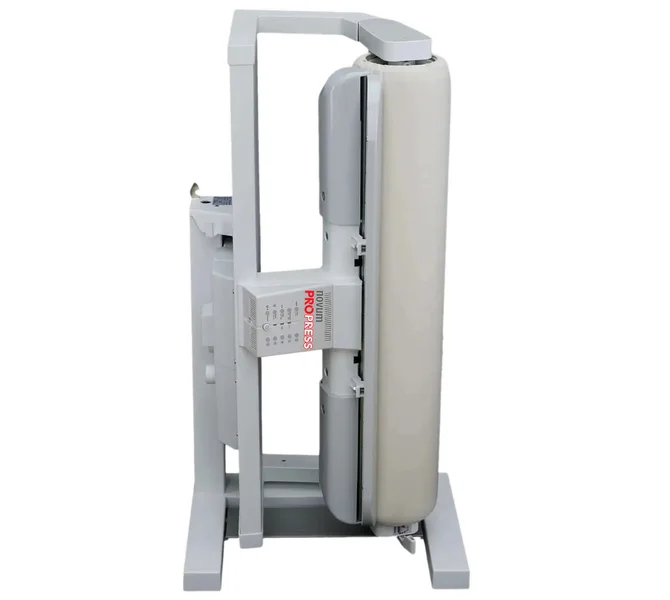
Folded down, a press takes about the floor space of a dining chair — worth checking before you buy.
09. Choosing one — and whether to bother
A beginner does not need an iron press. An ordinary iron and board are perfectly adequate while you are learning to thread a machine, and there are better places for the money early on. The question becomes real once sewing turns into a habit — particularly if that habit turns out to be quilting, dressmaking or home furnishings.
If you get the sewing machine out a few times a year for repairs, an iron is fine. If you are making clothes, quilts, curtains or bags regularly, four questions settle it:
• What do you make? Large projects benefit most from a wide pressing surface; small garments and crafts need less
• How often do you sew? The time saving compounds; occasional sewing does not repay it
• Where will it live? Check working dimensions and folded dimensions, and set the height so you are not stooping
• Do you need steam? Depends on your fabrics — cottons and linens benefit most, delicate synthetics least
Two practical notes. Shine is the risk people worry about most: pressing hard on the right side of a dark or tightly woven fabric can leave a permanent sheen, so use a press cloth on anything you cannot test first — roller presses are more forgiving here because the roller surface flexes over seams and buttons rather than flattening them. And use distilled water, or an anti-scale cartridge if you want to fill from the tap; limescale is what kills a steam system.
On comfort: a press removes the repeated back-and-forth of ironing, but you still handle and reposition fabric, so a comfortable working height matters as much as the specification.
Do not spend hundreds on fabric and forget the pressing
It is easy to buy a good sewing machine, good thread and beautiful cloth while treating pressing as an afterthought. But pressing is part of sewing, not tidying up after it. You can stitch a perfect seam and still end up with a garment that does not look as good as it should, purely because that seam was never properly set.
If you want better results from the skills you already have, your pressing equipment deserves the same consideration as the sewing machine you stitch with. GUR stocks ironing presses for dressmaking, quilting, crafts and general home use — and if you are unsure, work it out from what you actually make, how much fabric you handle, and how much of your sewing time currently goes on ironing.
View our range of ironing presses